Monday, 21 June 2010

X-rays, spectra and neutron stars

or, in other words, here's my new story:

XMM-Newton line detection provides new tool to probe extreme gravity

A long-sought-after emission line of oxygen, carrying the imprint of strong gravitational fields, has been discovered in the XMM-Newton spectrum of an exotic binary system composed of two stellar remnants, a neutron star and a white dwarf. Astronomers can use this line to probe extreme gravity effects in the region close to the surface of a neutron star. More...

Image credits: ESA

Thursday, 17 June 2010

More planets in the Universe - yay!

and here's an all-new story i wrote for ESA a few days ago... dedicated to all the fans of extra-solar planets - and little green men :-)

CoRoT unveils a rich assortment of new exoplanets

By detecting the faint dimming in the light emitted by stars during a transit event, CoRoT has detected six new exoplanets - each with its own peculiar characteristics - and one brown dwarf. One of these exoplanets, designated CoRoT-11b, has twice the mass of Jupiter and orbits a rapidly rotating star; this type of star is an extremely difficult target for exoplanet searches and its detection marks a significant achievement for the CoRoT team. More...

Image credits: CNES

Monday, 31 May 2010

Galaxy Clusters Rock

here's another news story I wrote that came out today... and again it's about two big, huge, massive galaxy clusters - yay!

Novel observing mode on XMM-Newton opens new perspectives on galaxy clusters

Surveying the sky, XMM-Newton has discovered two massive galaxy clusters, confirming a previous detection obtained through observations of the Sunyaev-Zel'dovich effect, the 'shadow' they cast on the Cosmic Microwave Background. The discovery, made possible thanks to a novel mosaic observing mode recently introduced on ESA's X-ray observatory, opens a new window to study the Universe's largest bound structures in a multi-wavelength approach. More...

enjoy :-)

Image credits: ESA/XMM-Newton; Background image: Blanco Cosmology Survey/NOAO/AURA/NSF; SZE contours: South Pole Telescope/NSF

Thursday, 6 May 2010

A wealth of infrared stories

this week i'm reporting from the Herschel First Results Symposium, ESLAB 2010, held at the European Space Research and Technology Centre, Noordwijk, The Netherlands. stated this way it does sound cool!

and finally my first 3 stories for ESA's Science & Technology website are online... they're intended to some sort of "interested" readership, but I guess it'll do no harm posting them here as well... :-)

they're about ESA's brand new space observatory, Herschel, which was launched almost a year ago and is now peering at the skies in the far-infrared domain of the electromagnetic spectrum.

the stories tell about some of the first results about 3 different types of objects on 3 very different cosmic scales: far, far away galaxies, massive stars forming in our own Galaxy and tiny water molecules in the regions where stars are formed. quite a spread of topics: take your pick!

Herschel reveals galaxies in the GOODS fields in a brand new light
The discovery of a previously unresolved population of galaxies in the GOODS fields and the first measurements of properties of galaxies in the almost unexplored far-infrared domain are among the first exciting scientific results achieved by Herschel's PACS and SPIRE instruments. These findings confirm the extraordinary capabilities of ESA's new infrared space observatory to investigate the formation and evolution of galaxies. More...

Herschel unveils rare massive stars in the act of forming
New images from ESA's Herschel space observatory reveal high-mass protostars around two ionised regions in our Galaxy. The detection of these rare stars in an early phase of evolution is key to understanding the mysterious formation of massive stars. More...


Herschel's HIFI follows the trail of cosmic water
Herschel's HIFI instrument was especially designed to follow the water trail in the Universe over a wide range of scales, from the Solar System out to extragalactic sources. Early results, presented this week at the Herschel First Results Symposium, demonstrate how HIFI uses water to probe the physical and chemical conditions in different regions of the cosmos. More...

Image credits: ESA/PACS Consortium/PEP Key Programme Consortium; ESA, PACS & SPIRE Consortia, A. Zavagno (Laboratoire d'Astrophysique de Marseille) for the Herschel HOBYS and Evolution of Interstellar Dust Key Programmes; ESA and the HIFI consortium; D. Johnstone for the WISH Key Programme (Background image: NASA/JPL-Caltech/S.T. Megeath, Harvard-Smithsonian CfA).

Wednesday, 5 May 2010

A "massive" press release

this is a photo release I wrote a couple of months ago while I was still an intern @ESO, but it just got published today... well, I wrote many more while I was there, but they were mostly about (arguably!) boring clouds of dust and gas where stars are born... this time instead I managed to write about real stuff for a change! finally something MASSIVE i.e. a galaxy cluster and weak lensing! and since the image was not that new, I made it pretty pedagogical, so here it is... enjoy :-)

A Cluster and a Sea of Galaxies

A new wide-field image released today by ESO displays many thousands of distant galaxies, and more particularly a large group belonging to the massive galaxy cluster known as Abell 315. As crowded as it may appear, this assembly of galaxies is only the proverbial “tip of the iceberg”, as Abell 315 — like most galaxy clusters — is dominated by dark matter. The huge mass of this cluster deflects light from background galaxies, distorting their observed shapes slightly.


When looking at the sky with the unaided eye, we mostly only see stars within our Milky Way galaxy and some of its closest neighbours. More distant galaxies are just too faint to be perceived by the human eye, but if we could see them, they would literally cover the sky. This new image released by ESO is both a wide-field and long-exposure one, and reveals thousands of galaxies crowding an area on the sky roughly as large as the full Moon.

These galaxies span a vast range of distances from us. Some are relatively close, as it is possible to distinguish their spiral arms or elliptical halos, especially in the upper part of the image. The more distant appear just like the faintest of blobs — their light has travelled through the Universe for eight billion years or more before reaching Earth.

Beginning in the centre of the image and extending below and to the left, a concentration of about a hundred yellowish galaxies identifies a massive galaxy cluster, designated with the number 315 in the catalogue compiled by the American astronomer George Abell in 1958 [1]. The cluster is located between the faint, red and blue galaxies and the Earth, about two billion light-years away from us. It lies in the constellation of Cetus (the Whale).

Galaxy clusters are some of the largest structures in the Universe held together by gravity. But there is more in these structures than the many galaxies we can see. Galaxies in these giants contribute to only ten percent of the mass, with hot gas in between galaxies accounting for another ten percent [2]. The remaining 80 percent is made of an invisible and unknown ingredient called dark matter that lies in between the galaxies.

The presence of dark matter is revealed through its gravitational effect: the enormous mass of a galaxy cluster acts on the light from galaxies behind the cluster like a cosmic magnifying glass, bending the trajectory of the light and thus making the galaxies appear slightly distorted [3]. By observing and analysing the twisted shapes of these background galaxies, astronomers can infer the total mass of the cluster responsible for the distortion, even when this mass is mostly invisible. However, this effect is usually tiny, and it is necessary to measure it over a huge number of galaxies to obtain significant results: in the case of Abell 315, the shapes of almost 10 000 faint galaxies in this image were studied in order to estimate the total mass of the cluster, which amounts to over a hundred thousand billion times the mass of our Sun [4].

To complement the enormous range of cosmic distances and sizes surveyed by this image, a handful of objects much smaller than galaxies and galaxy clusters and much closer to Earth are scattered throughout the field: besides several stars belonging to our galaxy, many asteroids are also visible as blue, green or red trails [5]. These objects belong to the main asteroid belt, located between the orbits of Mars and Jupiter, and their dimensions vary from some tens of kilometres, for the brightest ones, to just a few kilometres in the case of the faintest ones.

This image has been taken with the Wide Field Imager on the MPG/ESO 2.2-metre telescope at ESO’s La Silla Observatory in Chile. It is a composite of several exposures acquired using three different broadband filters, for a total of almost one hour in the B filter and about one and a half hours in the V and R filters. The field of view is 34 x 33 arcminutes.

Notes:

[1] The Abell catalogue from 1958 comprised 2712 clusters of galaxies, and was integrated with an additional 1361 clusters in 1989. Abell put together this impressive collection by visual inspection of photographic plates of the sky, seeking those areas where more galaxies than average were found at approximately the same distance from us.

[2] Ten percent of a galaxy cluster’s mass consists of a very hot mixture of protons and electrons (a plasma), with temperatures as high as ten million degrees or more, which makes it visible to X-ray telescopes.

[3] Astronomers refer to these slight distortions as weak gravitational lensing, as opposed to strong gravitational lensing, characterised by more spectacular phenomena such as giant arcs, rings and multiple images.

[4] A weak lensing study of the galaxy cluster Abell 315 has been published in a paper that appeared in Astronomy & Astrophysics in 2009 (“Weak lensing observations of potentially X-ray underluminous galaxy clusters”, by J. Dietrich et al.).

[5] The blue, green or red tracks indicate that each asteroid has been detected through one of the three filters, respectively. Each track is composed of several, smaller sub-tracks, reflecting the sequence of several exposures performed in each of the filters; from the length of these sub-tracks, the distance to the asteroid can be calculated.

Image credit: ESO/J. Dietrich

Saturday, 24 April 2010

Hubble's birthday and a contest

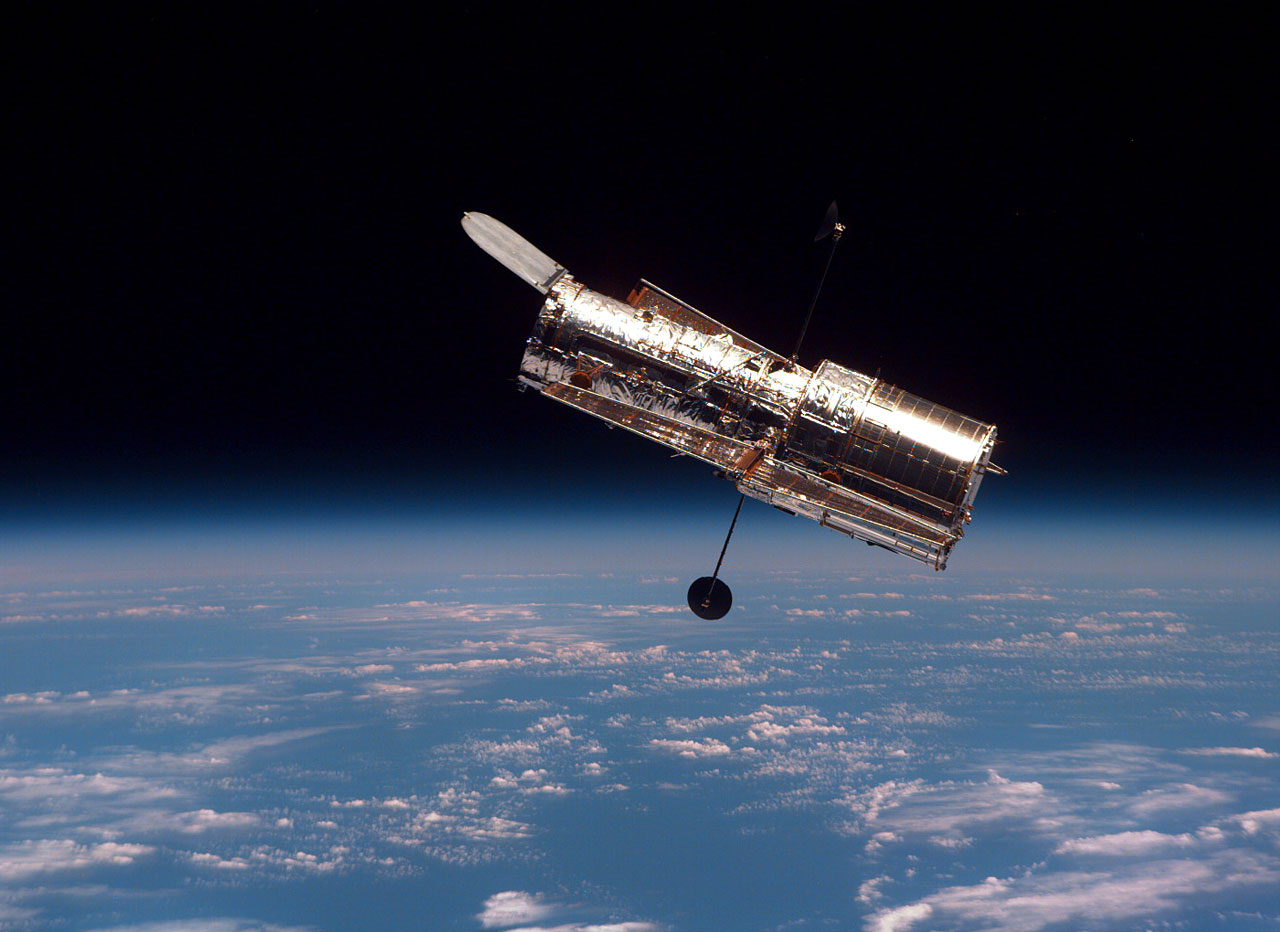
Hubble (the Space Telescope!) celebrates 20 years in orbit today... yep, it was 1990 when they kicked this bus-sized observatory out in space, although it was not until late 1993 that it started delivering "pretty pictures", due to a sperical aberration in the mirror which had to be fixed via a manned servicing mission.

But then, it was like a bullet set free: the nineties of last century were literally flooded with Hubble images, which went all the way from science magazines to all sort of products, ranging from desktop screensavers to super-cool animations in sci-fi movies, and so on... I was a teenager in those years (and kind of a "star-struck" one must I add) so I remember that pretty well, and I have no hesitation (although I did not study art nor communication) to state that Hubble images have largely affected the field of graphic design and, at the same time, the very perception of the Universe to the general public's eye.

That's why I'm promoting this contest, launched in honour of Hubble's 20th: search for Hubble images in popular culture and how they contributed shaping it. I find it pretty cool. Well, I must add I had quite a say in the whole thing... ;-) but I really think it will be nice, in the end, to look at all the funny pics collected by people all around the world.

If you're interested in the inter-connection between astronomy, science and popular culture, have a look at these two articles on related issues from The Guardian:
Art: the final frontier - 1st February, 2010
How science became cool - 13th April, 2010

In the image, likely Hubble's most iconic shot, are the so-called "pillars of creation", huge structures of gas and dust, in the Eagle Nebula, where newborn stars come to life. I must shyly admit this was my first desktop background in the late 1990s...
Credits: Jeff Hester and Paul Scowen (Arizona State University), and NASA/ESA.

Sunday, 11 April 2010

Venus Express Celebrates Four Years of Orbit and Discoveries

ESA’s Venus Express spacecraft celebrates today its fourth anniversary orbiting our planetary neighbour. During these four years of operations, the mission has thoroughly surveyed the atmosphere of Venus, unveiling several mysteries about the climate on this planet and highlighting some similarities with the one on Earth.


Launched on November 9, 2005 from the Baykonur cosmodrome in Kazakhstan, Venus Express was successfully inserted in orbit around the planet on April 11, 2006. Its elliptical orbit is highly eccentric, with a pericentre height of only 250 km and an apocentre distance of about 66,000 km. The choice of such an orbit makes both observations from a global point of view and zooming on certain regions possible. The so-called nominal mission took place between June 2006 and October 2007, a total of about 500 Earth days, which correspond to only two days on Venus, due to this planet’s extremely slow rotation; the mission kept collecting data in the following years as well, and most likely will continue until 2013.

Venus Express has enormously increased our knowledge about this planet. Thanks to these extraordinary data, it is now possible to characterise the distribution and composition of clouds on Venus in unprecedented detail.

Amongst the seven instruments on board Venus Express, the Venus Monitoring Camera (VMC) and the Visible and Infrared Thermal Imaging Spectrometer (VIRTIS) have investigated the thick layer of clouds covering Venus between 50 and 70 km above surface. The stunning images delivered by the two instruments, thanks to their exceptional spatial resolution ranging between 50 km to a few hundred metres, highlighted different patterns in the structure of the clouds. Patchy and fragmented clouds at low latitudes show the importance of tumultuous convective phenomena in the equatorial region, where the solar heating is more intense; this mottled scenario smoothly changes into a more streaky structure at mid latitudes, and into circular and spiral features in the polar regions.


The global vortex-like structure of Venus clouds is confirmed by a particularly striking feature, revealed in the infrared wavelengths by VIRTIS: a huge eddy rotating around the southern pole, its appearance varying from oval to S-shaped. Although the eye of this hurricane, about 1500 km across, is much larger than the typical size of hurricanes on Earth, this structure highlights a morphological similarity with the distribution of clouds on our own planet.


Another instrument aboard Venus Express, the Ultraviolet and Infrared Atmospheric Spectrometer (SPICAV/SOIR), studied the planet’s atmosphere indirectly, through a method called stellar occultation. As the spacecraft moves around Venus, its line of sight to a given star moves through the atmospheric layers, and the absorption of such light due to material in the atmosphere changes accordingly. By monitoring these variations over a sample of 30 stars, it was possible to probe the vertical structure of the atmosphere of Venus, revealing an upper haze that surprisingly extends up to an altitude of 90 km.

Besides these exciting discoveries regarding the morphology of the planet’s clouds, during the past four years Venus Express also conducted extensive studies of the atmospheric composition and even peered through it, exploring the surface of the Earth’s sister planet.

--------

This story was also an exercise (and a pretty successful one I must say!) and is based on "Venus express: Highlights of the nominal mission" by D.V. Titov et al, published in 2009 on Solar System Research, Volume 43, Issue 3, pp.185-209.

In the images:
* An artist's impression of Venus Express
(Credits: ESA; Image by AOES Medialab)
* A map of the venusian clouds, with infrared (lower left) data derived from the Visible and Infrared Thermal Imaging Spectrometer, VIRTIS, on the planet’s night-side and ultraviolet (upper right) data captured by the Venus Monitoring Camera, VMC, of the day side
(Credits: ESA/MPS/DLR/IDA and ESA/VIRTIS/INAF-IASF/Obs. de Paris-LESIA)
* The ‘eye of the hurricane’ close to Venus's south pole (indicated by a yellow dot) as imaged by the Visible and Infrared Thermal Imaging Spectrometer (VIRTIS) on board Venus Express
(Credits: ESA/VIRTIS/INAF-IASF/Obs. de Paris-LESIA/Univ. of Oxford)