Thursday, 10 March 2011

Extremely Young and Incredibly Old

here's my new story about a newly discovered cluster of galaxies, which is located in the young Universe but it is, surprisingly, already pretty old... enjoy :-)

An old galaxy cluster discovered in the young Universe

Astronomers working with data from several observatories, including ESA's XMM-Newton, have discovered the most distant, mature galaxy cluster yet. The cluster is seen as it was when the Universe was only about a quarter of its current age. In contrast to other structures observed in the young Universe, this object is already in its prime, as is evident from its diffuse X-ray emission and evolved population of galaxies. This shows that fully-grown galaxy clusters were already in place this early in cosmic history. More...

Image Credits: ESA/ESO/Subaru/R.Gobat et al.

Wednesday, 16 February 2011

Dark stuff that matters

here's a new story, maybe a teeny bit longer than usual, about the dark 'nests' where the most frenzied galaxies in cosmic history are born...

Herschel quantifies the dark matter threshold for starburst galaxies

How much dark matter is needed to trigger a starburst in the cosmic cribs where galaxies are born? A new study, based on data from ESA's Herschel Space Observatory, has revealed that dark matter halos with a mass larger than 300 billion times the Sun's are particularly efficient at igniting massive starbursts, as they house the most active star-forming galaxies in the Universe. Astronomers have discovered this key threshold by measuring small fluctuations in the Cosmic Infrared Background, the integrated diffuse emission produced by the dust from every galaxy that ever existed. These fluctuations trace the distribution of otherwise mostly unresolved star-forming galaxies and of the dark matter halos that enshroud them. More...

Image credits: The Virgo Consortium/Alexandre Amblard/ESA

Wednesday, 19 January 2011

When a candle gets 'crabby'

Here's a new story about what is standard and what isn't — in astronomy. Incidentally, setting and adjusting to new and old standards is a topic which I recently find more and more interesting when applied to a number of other contexts as well...

The Crab Nebula: standard candle no more?

Teaming up with other telescopes monitoring the Crab Nebula, ESA's INTEGRAL observatory has made a significant contribution to demonstrating that this source, previously believed to be a standard candle, might not be so reliable, after all. The small, but measurable dimming of what was until now considered to be one of the brightest and, most importantly, the steadiest source in the high-energy sky calls for a re-examination of how X-ray and gamma-ray observations are calibrated. More...

Image credits: X-ray: NASA/CXC/SAO/F. Seward; Optical: NASA/ESA/ASU/J. Hester & A. Loll; Infrared: NASA/JPL-Caltech/Univ. Minn./R. Gehrz

Lots of cool stuff

after a long break I'm back with no less than 5 new articles about what can arguably be described as my favourite spacecraft, Planck!! the stories cover a bunch of really cool results that have been achieved from its early data and presented at a conference in Paris last week, spanning a wide range of astronomical objects that will suit everyone's palate — from tiny dust grains in our Galaxy all the way to the huge galaxy clusters and the distribution of galaxies on the largest scales. enjoy :)

Planck's first science results and the release of an extensive compact source catalogue
The Planck Collaboration presents the first science results to emerge from the mission, covering compact and diffuse foreground emission sources, at a conference held from 10 to 14 January 2011 in Paris, France. These results are accompanied by the release of the first Planck product to be publicly distributed: the Early Release Compact Source Catalogue, a highly robust compilation of compact sources detected in each of the telescope's nine channels. Eagerly awaited by the scientific community, the catalogue contents span a wide variety of astronomical sources, and also includes a sample of galaxy clusters detected through the Sunyaev-Zel'dovich effect and a list of cold molecular cloud cores distributed throughout the Milky Way. More...

Planck's successful hunt probes galaxy clusters on very broad mass range
The first all-sky survey of galaxy clusters detected via the Sunyaev-Zel'dovich effect is amongst the highlights presented by the Planck Collaboration at a conference held from 10 to 14 January 2011 in Paris, France. The survey, which has benefited from a fruitful collaboration with ESA's XMM-Newton observatory, probes a wide range of cluster masses and other properties, which is unprecedented for a Sunyaev-Zel'dovich sample. Along with the first results enabled by the survey, the Early Sunyaev-Zel'dovich Cluster sample is being publicly released, providing the community with a robust data set for further studies and follow-up observations of galaxy clusters. More...

Planck traces the coldest objects in the nearby Universe
With its power to detect cosmic material at unprecedentedly low temperatures, Planck has completed the first unbiased, all-sky survey of compact cold and dusty objects in the Milky Way and, at the same time, the first all-sky survey of cool dust in other galaxies. These extensive data sets allow astronomers to shed new light on the earliest phases of star formation. The public release of the Planck Early Cold Core Catalogue will offer the community a large number of new, cold galactic targets to be studied with other telescopes, including ESA's Herschel Space Observatory. More...

Planck sees new, mysterious components in Milky Way and Magellanic Clouds
Thanks to its broad spectral coverage and very high sensitivity, Planck is peering deep into the interstellar medium of the Milky Way and discovering new components and physical mechanisms taking place therein. The results emerging from Planck's first all-sky survey include strong evidence for the presence of extremely rapidly spinning dust grains, an excess emission explained in terms of a previously poorly quantified 'dark gas' and the characterisation of an excess emission arising from the interstellar medium that permeates the Small Magellanic Cloud, a nearby galaxy orbiting our own Milky Way. More...

Planck sees traces of early structure formation in the cosmic infrared background
While targeting the Cosmic Microwave Background, Planck has also captured another important diffuse radiation, the Cosmic Infrared Background, which consists of the light emitted by all galaxies since their formation. This signal, detected by Planck at submillimetre wavelengths, exhibits a high degree of structure and enables astronomers to investigate the still unclear link between star-forming galaxies and the underlying distribution of dark matter, up to the earliest phases of the formation of cosmic structure. More...

Image credits: ESA and the Planck Collaboration

Friday, 3 December 2010

Just like archaeologists

here's a new article about astronomical measurements of radioactive elements in some stars that remind us of the way archaeologists date their samples. apparently, a highly appreciated comparison!! enjoy :-)

INTEGRAL helps unravel the tumultuous recent history of the solar neighbourhood

Just like archaeologists, who rely on radioactive carbon to date the organic remains from past epochs, astronomers have exploited the radioactive decay of an isotope of aluminium to estimate the age of stars in the nearby Scorpius-Centaurus association, the closest group of young and massive stars to the Sun. The new observations, performed in gamma rays by ESA's INTEGRAL observatory, provide evidence for recent ejections of matter from massive stars that took place only a few million years ago in our cosmic neighbourhood. More...

Image credits: ESA

Friday, 19 November 2010

Hot gas fountains and the galactic spa

here's a new article that came out today about new data confirming a mechanism where hot gas bursts out of the Milky Way's disc and into the galactic halo, giving rise to so-called galactic fountains:

New evidence for supernova-driven galactic fountains in the Milky Way

Observing the X-ray-bright gas in the halo of the Milky Way, ESA's XMM-Newton has gathered new data which favour a process involving fountains of hot gas in our Galaxy. Such a scenario, with the gas flowing from the galactic disc into the halo where it then condenses into cooler clouds and subsequently falls back to the disc, confirms the importance of supernova explosions in forging the evolution of the interstellar medium and of the entire Galaxy. More...

Image credits: ESA

Thursday, 4 November 2010

lenses in the sky – without diamonds

and finally a new story about cosmology and a good old friend of yours truly, i.e. gravitational lensing... yay!

New method reveals gravitationally lensed galaxies in Herschel-ATLAS first survey

Astronomers using early data from one of the largest projects to be undertaken with the ESA Herschel Space Observatory have demonstrated that virtually all bright sub-millimetre galaxies in the distant Universe are subject to gravitational lensing, which amplifies their flux thus easing their detection and characterisation. Analysis of less than three per cent of the entire Herschel-ATLAS survey, which probes the distant and hidden Universe, yielded a first sample of five lensed galaxies and paves the way for the compilation, in the near future, of a rich catalogue of distant, star-forming and dust-obscured galaxies. More...

Image credits: ESA/NASA/JPL-Caltech/Keck/SMA

Thursday, 14 October 2010

hidden magnetism

lots of new stories these days – yay!
this one's about a really curious object... enjoy :-)

Are most pulsars really magnetars in disguise?

Astronomers using XMM-Newton and other world-class X-ray telescopes have probed a curious source, which emits flares and bursts just like a magnetar but lacks the extremely high external magnetic field typical of these objects. The detection of this source, which could be powered by a strong, internal magnetic field hidden to observations, may mean that many 'ordinary' pulsars are dormant magnetars waiting to erupt. More...

Image credits: ESA

Wednesday, 13 October 2010

you rock — you rule!

here's a new story about rocks, I mean, asteroids :-)

Hubble and Rosetta unmask nature of recent asteroid wreck

High-resolution images from the Hubble Space Telescope and a rare view obtained, from a unique perspective, by the Rosetta spacecraft provide a comprehensive picture of P/2010 A2, a puzzling body in the asteroid main belt. Although similar in appearance to a comet, this object and its diffuse trail have been exposed as the remnant of an asteroid crash that happened only one and a half years ago. More...

Image credits: ESA – OSIRIS-Team; MPS/UPD/LAM/IAA/RSSD/INTA/UPM/DASP/IDA

Thursday, 7 October 2010

Venus' draggin' and twistin' atmosphere

here's a new story I wrote in the last couple of days for ESA about some cool experiments to study the atmosphere of our sister planet Venus:

Venus Express probes the planet's atmosphere by flying through it

ESA's Venus Express is exploring the density of the Venusian upper atmosphere by measuring how much the planet's atmosphere itself slows down or twists the pointing of the spacecraft. New density measurements, centred on the Northern Pole and obtained during these atmospheric drag experiments, show an unexpected inhomogeneous pattern in the atmosphere of our neighbouring planet. More...

Image credit: ESA

Wednesday, 22 September 2010

It's always sunny in SOHO

well, I actually meant to write "on SOHO" as in the Sun-watching telescope I just wrote a new story about for ESA... of course it's always sunny there, being outside of the Earth's atmosphere! but since it's been unusually sunny here in Munich for quite some days, the title seemed more than appropriate :-)

and if you want to find out more about observations of the Sun in the past decade and a half... here are a few fun facts:


A change of pace for EIT, the ground-breaking Sun-watching camera

For almost 15 years, the EIT camera on board SOHO transmitted a picture of the solar corona every 12 minutes, providing ground-breaking observations of the Sun that changed our perception and understanding of our star. After a remarkable career, this instrument has now eased into semi-retirement. Although no longer as active as during its heyday, EIT will still provide snapshots of the Sun - at a more leisurely pace. More...

Image credits: ESA/NASA - SOHO/EIT

Wednesday, 15 September 2010

Planck & clusters: SO cool

Here is a new story I just wrote for ESA about my favourite satellite, Planck, and its newest observations of big, huge, beautiful galaxy clusters... enjoy :-)

Planck's first glimpse at galaxy clusters and a new supercluster

Surveying the microwave sky, Planck has obtained its very first images of galaxy clusters, amongst the largest objects in the Universe, by means of the Sunyaev-Zel'dovich effect, a characteristic signature they imprint on the Cosmic Microwave Background. Joining forces in a fruitful collaboration between ESA missions, XMM-Newton followed up Planck's detections and revealed that one of them is a previously unknown supercluster of galaxies. More...

Image Credits: ESA/ LFI & HFI Consortia

Thursday, 2 September 2010

Eau de étoile

here's a new story about water being unexpectedly found in an old star dominated by carbon... and a possible explanation for that:

Herschel detection explains the origin of water in a carbon star

ESA's Herschel Space Observatory has detected water vapour in a location previously thought to be impossible - in the atmosphere of an ageing, red giant carbon star. The rich and detailed data provided by Herschel can be explained within a new framework in which ultraviolet photons play a key role. More...

Image credits: ESA/PACS/SPIRE/MESS Consortia

Wednesday, 11 August 2010

Hard X-rays, tough stuff

Here's my latest story, just came out today... the topic's pretty technical but I hope I managed to break it down to the basics. Let's see: essentially, a satellite named INTEGRAL is surveying the sky seeking very high-energy photons (in this case, so-called hard x-rays) coming from a series of objects throughout our own Galaxy and from far away galaxies as well. Now, a new method has been developed to make it work even better.

For those (possibly!!) interested in further details... enjoy :-)


INTEGRAL completes the deepest all-sky survey in hard X-rays

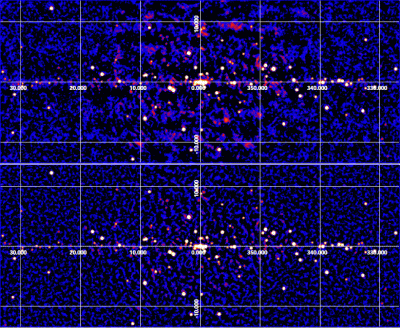
A newly developed image analysis technique has significantly improved the sensitivity limits reached by the IBIS imager on board INTEGRAL, resulting in the deepest survey ever compiled of the entire sky in the energy range between 17 and 60 keV. Pushing the instrument towards its very limits, the novel method discloses a vast number of previously undetected faint sources, galactic and extragalactic alike. More...

Image credit: R. Krivonos et al, 2010

Monday, 5 July 2010

The coolest thing

over a year ago i was blogging about Planck and how all astrophysicists and cosmologists were overwhelmingly excited about its launch... and now, finally my first news story about this brand-new observatory is online!

there's no science yet - just a pretty picture... super pretty actually! or better, super cool :-)

Planck all-sky image depicts galactic mist over the cosmic background

An all-sky image from Planck's recently completed first survey highlights the two major emission sources in the microwave sky: the cosmic background and the Milky Way. The relic radiation coming from the very early Universe is, to a large extent, masked by intervening astronomical sources, in particular by our own Galaxy's diffuse emission. Thanks to Planck's nine frequency channels, and to sophisticated image analysis techniques, it is possible to separate these two contributions into distinct scientific products that are of immense value for cosmologists and astrophysicists, alike. More...

Image Credit: ESA, HFI and LFI consortia.

Friday, 2 July 2010

Just one step away

finally, after an incubation of several (!) months, the article I wrote with a colleague during my internship at ESO has been published on Science in School! it's about ALMA, a huge radiotelescope that is currently being built in the desert of northern Chile...

...and it's supposed to be read by young kids in their last years of school, so we tried to make it catchy and pedagogic at the same time — tough task, hope it works :-)


The ALMA Observatory: the sky is only one step away

Imagine hiking in the Atacama region, high in the Andes of northern Chile, one of the driest and remotest spots on Earth. At altitudes of 5000 m and higher, life is not easy here: the atmospheric pressure is much lower than at sea level, and oxygen is scarce.

The landscape, dominated by large volcanoes and other mountain peaks, occasionally decorated by salt flats and picturesque formations of ice and snow, hardly resembles a typical view of our planet. Then, in the midst of this arid and abandoned region, you become aware of a gigantic construction — could those be huge satellite dishes?

[...]

Read the full text on the website of Science in School.

In the image, an ALMA antenna on the Chajnantor plateau, in northern Chile. Image credits: ALMA (ESO/NAOJ/NRAO)

The electromagnetic spectrum - reprise

I am writing this post following a thread that I started over a year ago about a topic that I am very fond of: the electromagnetic spectrum, which I believe is (unfortunately!) not a widely understood concept. ever since I wrote that post, I wanted to spend a few words and explain what all the fuzz is about - but of course I never had time for that...

then, a few months ago, I had the chance to write a story about ALMA, a world-class radio telescope, and since the story was supposed to be addressed to school kids, I thought - what a cool opportunity to try and explain this topic once and for all... so I convinced the editors of Science in School to have a separate box about it. space on the magazine is always scarce, but I tried to do my best - in less than 200 words!!


Detecting astronomical objects along the electromagnetic spectrum

Visible light is just a small part of the whole spectrum of electromagnetic radiation. The different parts of the spectrum, or spectral bands, are, in order of decreasing wavelength and increasing frequency: radio waves (including microwaves and (sub)millimetre radiation), infrared, visible, ultraviolet, X-rays and gamma rays.

Because different physical processes in the Universe emit light at different wavelengths, each class of objects in the Universe shines most brightly in one or several particular spectral bands. Modern astronomers often try to target many bands, using different telescopes, since each set of observations provides a complementary piece of the puzzle; this approach is called multi-wavelength astronomy.

However, Earth’s atmosphere complicates matters, because it absorbs most of the radiation. Although this protects us, it makes life difficult for astronomers: only a tiny fraction of the electromagnetic spectrum is observable from the ground, and often in these cases, the quality of the observations strongly depends on the geographical site. This is why choosing an excellent site such as Chajnantor for ALMA is so important. In other spectral bands, especially at very short wavelengths, astronomers need telescopes aboard satellites in orbit around our planet, outside the obscuring layer of the atmosphere.
---

The image above displays the atmospheric opacity - the level of the brown curve represents how opaque the atmosphere is at the given wavelength. The major windows are at visible wavelengths (marked by the rainbow) and at radio wavelengths from about 1 mm to 10 m. Observations at wavelengths where the atmosphere is opaque require space telescopes.

Image credits: ESA/Hubble/F.Granato

Monday, 21 June 2010

X-rays, spectra and neutron stars

or, in other words, here's my new story:

XMM-Newton line detection provides new tool to probe extreme gravity

A long-sought-after emission line of oxygen, carrying the imprint of strong gravitational fields, has been discovered in the XMM-Newton spectrum of an exotic binary system composed of two stellar remnants, a neutron star and a white dwarf. Astronomers can use this line to probe extreme gravity effects in the region close to the surface of a neutron star. More...

Image credits: ESA

Thursday, 17 June 2010

More planets in the Universe - yay!

and here's an all-new story i wrote for ESA a few days ago... dedicated to all the fans of extra-solar planets - and little green men :-)

CoRoT unveils a rich assortment of new exoplanets

By detecting the faint dimming in the light emitted by stars during a transit event, CoRoT has detected six new exoplanets - each with its own peculiar characteristics - and one brown dwarf. One of these exoplanets, designated CoRoT-11b, has twice the mass of Jupiter and orbits a rapidly rotating star; this type of star is an extremely difficult target for exoplanet searches and its detection marks a significant achievement for the CoRoT team. More...

Image credits: CNES

Monday, 31 May 2010

Galaxy Clusters Rock

here's another news story I wrote that came out today... and again it's about two big, huge, massive galaxy clusters - yay!

Novel observing mode on XMM-Newton opens new perspectives on galaxy clusters

Surveying the sky, XMM-Newton has discovered two massive galaxy clusters, confirming a previous detection obtained through observations of the Sunyaev-Zel'dovich effect, the 'shadow' they cast on the Cosmic Microwave Background. The discovery, made possible thanks to a novel mosaic observing mode recently introduced on ESA's X-ray observatory, opens a new window to study the Universe's largest bound structures in a multi-wavelength approach. More...

enjoy :-)

Image credits: ESA/XMM-Newton; Background image: Blanco Cosmology Survey/NOAO/AURA/NSF; SZE contours: South Pole Telescope/NSF